


WELD STRENGTH TORQUE TEST ON WELDED MESH PANELS

Welding quality is essential to the structural integrity and reliability of welded mesh fence panels. During production, Giant Fence conducts a weld strength torque test on semi-finished mesh panels to assess the strength and integrity of welded intersections.

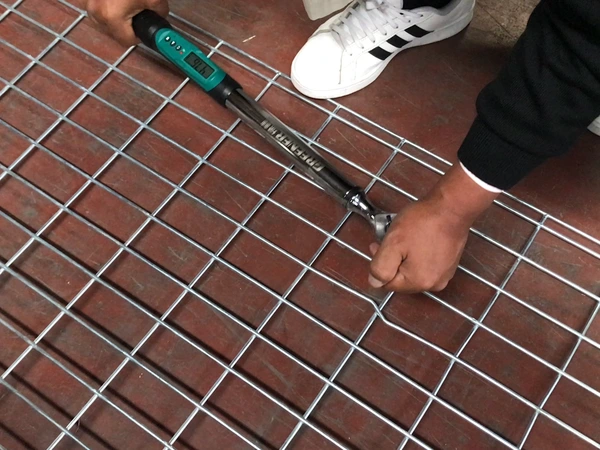
A digital torque wrench is used to apply controlled torque to selected welded intersections, checking whether the joints remain securely connected without cracking, loosening or breaking.

By inspecting the welded connections during and after testing, we can identify potential welding defects and assess welding consistency before the panels proceed to subsequent production stages.

Weld strength torque test on a wire mesh panel using a digital torque wrench.

TEST PURPOSE

This test evaluates the integrity and strength of welded joints on semi-finished mesh panels under applied torque. The test helps to:

  • Assess the strength of welded intersections.
  • Evaluate the resistance of welded joints to twisting forces.
  • Identify weak welds or potential welding defects.
  • Check for cracking, loosening or breakage at welded connections under load.
  • Support consistent welding quality during production.
TEST PROCEDURE

The weld strength torque test is conducted through the following steps:

  1. Sample preparation: Select semi-finished welded mesh panels and identify representative weld points for testing.
  2. Tool preparation: Prepare a digital torque wrench and verify that it is correctly set up.
  3. Panel positioning: Secure the mesh panel to keep it stable throughout the test.
  4. Torque application: Use the digital torque wrench to apply controlled torque to the selected welded intersections.
  5. Weld inspection: Inspect the welded areas during and after testing for cracks, separation, loosening or other visible damage.
  6. Result assessment: Record the applied torque readings and assess the condition of the welded joints against internal quality requirements.
WHAT THE TEST EVALUATES

This test evaluates the following key aspects of welded mesh quality:

  • Weld joint strength: Assesses the ability of welded intersections to withstand applied torque.
  • Weld integrity: Checks whether welded joints remain securely connected during testing.
  • Resistance to mechanical stress: Examines how welded joints respond to twisting forces.
  • Welding consistency: Helps identify variations in weld quality between test points.
  • Potential welding defects: Identifies cracking, separation, loosening or breakage at welded connections.
RELIABLE WELDING THROUGH PRACTICAL TESTING

Weld strength is essential to the overall quality and structural reliability of welded mesh fence panels. By applying controlled torque with a digital torque wrench and inspecting the welded intersections, Giant Fence assesses weld integrity in semi-finished mesh panels and helps identify potential welding defects during production. This testing process supports consistent manufacturing quality and reflects our commitment to reliable fencing products.

TEST VIDEO

Weld strength torque test